
Primary reflexes
Primary Reflexes: when the body stays on “high alert”
As babies we rely on in‑built (primary) reflexes. As the nervous system matures, these reflexes should step back so purposeful movement, attention, and learning can take the lead. When a reflex hangs on longer than it should, kids can look clumsy, distracted, anxious, or simply exhausted from trying so hard. This page gives parents a clear, practical overview.
Moro Reflex
Why we have it
Moro is the classic startle—arms fly out, then hug in—triggering a burst of alertness and a call for help. It prepares the infant to react fast to changes in light, sound, movement.
When it stays active
A retained Moro keeps the system hyper‑vigilant. Adrenaline surges, sleep is lighter, and sensory filters are thin. Focus comes in short bursts and crashes after noisy, busy periods.
What parents tend to notice
Sudden sounds make the whole body jump. In class, movement in the periphery pulls attention away from the teacher. By late afternoon your child is wired‑and‑tired—chatty, impulsive, then tearful. Settling to sleep takes a long runway. You may notice co‑movements: mouth opens when writing, shoulders lift when eyes track across the page.
Overview
-
Purpose: fast “alert and regroup” response.
-
If retained: sensory overload, poor settling, big emotional swings.
-
Seen as: easy startle, short focus, restless evenings.

ATNR — Asymmetrical Tonic Neck Reflex
Why we have it
ATNR (the “fencer’s pose”) supports early hand‑eye links, rolling, and reaching across the body. Turning the head extends one side and flexes the other—useful in early movement mapping.
When it stays active
The head turn continues to drive the arm and eye, making crossing the midline and bilateral coordination harder. Eye tracking across a page is jerky; handwriting competes with head position.
What parents tend to notice
During writing the head drifts to one side and the writing arm follows; the other hand clamps the desk. Paper angles grow dramatic. Reading lines are skipped; the bookmark becomes essential. In sports, throwing looks awkward if the head and arm won’t work independently. Overflow shows up as tongue peeking out or foot bracing during fine‑motor work.
Overview
-
Purpose: builds early hand‑eye coordination for rolling/reaching.
-
If retained: midline crossing, tracking, and bilateral skills suffer.
-
Seen as: paper turning, head‑arm coupling, reading/writing fatigue.

Spinal Galant Reflex
Why we have it
Triggered by touch along the low back, Spinal Galant helps the baby wriggle through the birth canal and later aids trunk movement and hip shift.
When it stays active
Touch near the waistband is overly alerting. Sitting still is hard because the low back is “on.” The bladder can be affected, especially at night.
What parents tend to notice
In class your child wriggles, slides, and hooks feet around the chair. Waistbands and labels are enemies. A light tap on the low back makes the trunk bend away. Nighttime bedwetting may persist beyond the typical age. You may see one hip rotate more than the other while walking.
Overview
-
Purpose: aids birth and early trunk/hip movement.
-
If retained: fidgeting with seating, tactile defensiveness at the waist, possible bedwetting.
-
Seen as: constant chair‑adjusting, clothing sensitivity.

TLR — Tonic Labyrinthine Reflex
Why we have it
TLR links head position and muscle tone via the vestibular system. It helps the infant learn gravity—curling in (flexion) and stretching out (extension)—laying the base for upright posture.
When it stays active
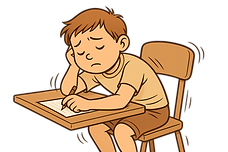
Postural control is effortful. The child “spends” attention on sitting up, leaving less for thinking. Spatial concepts and body‑in‑space awareness can lag; fatigue arrives early during desk tasks.
What parents tend to notice
Homework starts well, then the chin sinks into the hand, shoulders round, and legs hook the chair. Writing stretches uphill as stability fades. After ten minutes: sighs, fidgeting, “My brain is tired.” Gross‑motor play looks tentative on uneven ground; escalators or busy staircases feel uncomfortable.
Overview
-
Purpose: calibrates tone against gravity for posture.
-
If retained: slumped sitting, fast fatigue, weaker spatial organization.
-
Seen as: propping the head, whole‑body tension during desk work.
STNR — Symmetrical Tonic Neck Reflex
Why we have it
STNR appears around 6–9 months to separate upper‑ and lower‑body movement and to prepare for crawling. Looking up tends to extend the arms and flex the hips; looking down flexes the arms and extends the hips.
When it stays active
Desk posture and near‑far focusing are hard. The head position still “pulls” the limbs, so copying from the board and swimming coordination are challenging. Crawling may have been brief or skipped.
What parents tend to notice
Your child sprawls onto the desk or slides under it. “W‑sitting” shows up often. Copying from the board looks like a ping‑pong match—up, down, lose the spot, repeat. Ball skills that require head‑arm‑leg timing feel frustrating. Overflow shows as toe curling or jaw clenching when looking up.
Overview
-
Purpose: bridges to crawling; separates upper/lower body.
-
If retained: desk posture, near‑far focus, and coordination suffer.
-
Seen as: W‑sitting, lying on desk, losing place when copying.

Palmar (hand grasp) Reflex
Why we have it
The newborn’s palm closes around touch to promote bonding and early hand use. Integration allows pincer grasp, in‑hand manipulation, and fluent handwriting.
When it stays active
Touch or pressure in the palm triggers an automatic squeeze. The thumb struggles to oppose. Fine‑motor tasks recruit the mouth and face (the Babkin response), tying up speech while the hands work.
What parents tend to notice
The pencil grip is tight and tiring; erasing rips the paper. During tricky tasks the lips purse, tongue peeks out, or the whole arm stiffens. Cutting, tying laces, and fasteners are slow and effortful.
Overview
-
Purpose: early grasp for bonding and basic hand use.
-
If retained: tight grip, unstable thumb, mouth‑hand co‑activation.
-
Seen as: fatigued handwriting, dropped scissors, “my hands won’t listen.”

Plantar (foot grasp) Reflex
Why we have it
The newborn toes curl to help with early stability and contact. With walking, the foot should accept weight across the whole sole with relaxed toes.
When it stays active
Toes curl against the shoe or floor, nudging the child toward toe‑walking and making balance at standstill harder. Foot care and shoe shopping can be a battle.
What parents tend to notice
At fittings the foot jerks back the moment the insole touches the sole. Toenail trimming is tense. Standing in line looks wobbly; first steps are bouncy on the fronts of the feet.
Overview
-
Purpose: early stability via toe curl.
-
If retained: toe‑walking tendency, shaky balance, shoe sensitivity.
-
Seen as: resistance to shoes, fight over toenails, restless stance.

Rooting & Sucking Reflexes
Why we have them
These feeding reflexes help a newborn find the nipple and coordinate suck–swallow–breathe. As the mouth matures, they should yield to voluntary chewing, swallowing, and clear speech.
When they stay active
The tongue rests forward, lips hang open, and the head drifts ahead of the shoulders. Breathing moves to the mouth; drooling and picky textures are common. Timing breath with speech or eating is tricky.
What parents tend to notice
Your child seeks oral input—chews sleeves, pencil tops, hoodie strings. Soft, predictable foods are preferred; mixed textures cause a grimace. During reading, the mouth opens slightly and the voice sounds nasal when congested.
Overview
-
Purpose: early feeding and airway protection.
-
If retained: mouth breathing, drooling, picky textures, dental crowding risk.
-
Seen as: chewing clothing, forward head, frequent sips during meals.

When to reach out
-
If several features fit for one reflex, or the challenges affect learning, speech, attention, or self‑care.
-
If your child seems “over‑sensitive” in some areas and “under‑responsive” in others (touch, taste, balance), it may be a sensorimotor pattern linked with retained reflexes.
How we can help?
Reach out for us at CortexHelp.
At Cortex Help, we specialize in Neuro-Developmental Stimulation techniques to inhibit primary reflexes. Our approach is rooted in the concept of reshaping and reprogramming brain patterns, thereby fostering optimal neurological development. At the first visit we use simple checks (posture, balance, eye–hand tasks, a quick drawing) and design playful, home‑friendly activities to build steady foundations.
Do the online course CortexKids at home.
The idea for CortexKids grew during the COVID-19 lockdowns, when clinics, preschool prep clubs, and kids’ sports were suddenly off-limits. Parents kept asking, “What can we do at home that actually helps?” I built this program so you’d have clear, high-quality guidance you can use in your living room—no special equipment, just consistency and play.
We start with the big foundations: gross motor skills, whole-body coordination, and a child’s sense of space and direction. As those get steadier, we layer in fine motor and pre-writing (graphomotor) tasks, visual and auditory processing games, and activities that build attention and memory. Step by step, your child practices the core abilities that make classroom life easier—sitting well, following directions, copying from the board, listening in noise, and getting thoughts onto paper.
It’s also meant to be fun. You’ll spend quality time together jumping, rolling like a log, stringing bead “necklaces,” tossing and catching, drawing, and playing simple, clever games. The plan gives you enough variety for the whole (pre)school year while steadily developing the skills your child needs for a confident start to school.